


















Understanding SIM Cards and Your Phone’s Unique Identification Codes

Every smartphone contains several unique identification numbers that help connect it to mobile networks, verify its authenticity, and ensure secure communication. While most users are familiar with the SIM card, fewer know about codes like the IMEI, ICCID, and EID, all of which play an important role in your device’s operation.
In this article, we’ll explain what these codes mean, where to find them, and why they matter.
What Is a SIM Card?
A Subscriber Identity Module (SIM) is a small smart card that allows your phone to connect to your mobile carrier’s network.
The SIM stores information such as:
- Your mobile phone number
- Your subscriber identity
- Network authentication credentials
- Carrier settings
- Security information
Without a valid SIM card—or an active eSIM profile—your phone cannot make calls, send SMS messages, or use mobile data.
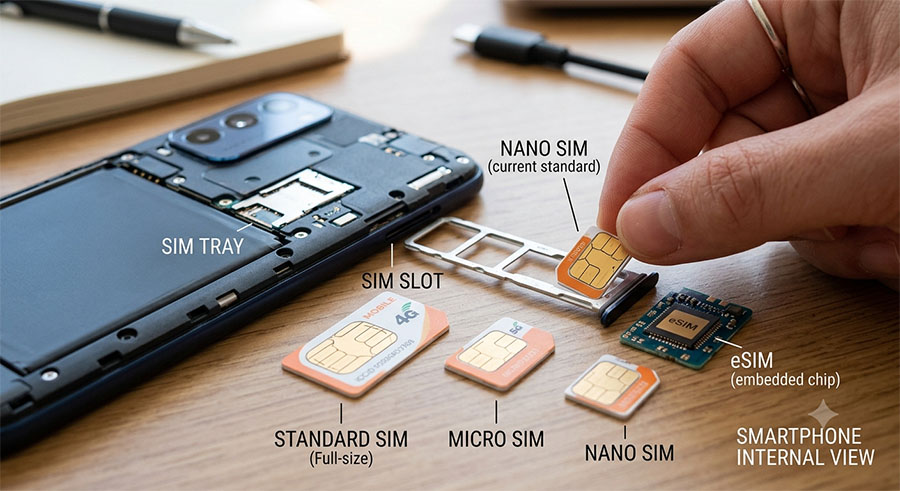
Types of SIM Cards
Modern smartphones support different SIM technologies:
Standard SIM
The original full-size SIM, now rarely used.
Micro SIM
Smaller than the standard version and common in older smartphones.
Nano SIM
The current industry standard used by most Samsung, Apple, Xiaomi, Motorola, and Google devices.
eSIM
An embedded digital SIM built directly into the smartphone. Instead of inserting a physical card, users download a carrier profile electronically.
What Is an IMEI Number?
The International Mobile Equipment Identity (IMEI) is a unique 15-digit number assigned to every mobile phone.
Think of it as your phone’s fingerprint.
The IMEI allows:
- Mobile carriers to identify the device
- Police to identify stolen phones
- Manufacturers to verify warranty information
- Repair centers to identify the exact model
No two phones share the same IMEI.
Where Can You Find Your IMEI?
You can locate the IMEI in several ways:
- Dial *#06#
- Go to Settings → About Phone
- Check the SIM tray (on many Samsung models)
- Look at the original retail box
- View the label inside the phone (on some models)
Dual SIM phones usually have two IMEI numbers—one for each SIM slot.
What Is the ICCID?
The Integrated Circuit Card Identifier (ICCID) is the unique serial number assigned to your SIM card.
Unlike the IMEI, which identifies the phone, the ICCID identifies the SIM itself.
Your carrier uses the ICCID to:
- Activate your SIM
- Transfer your phone number
- Manage your account
- Replace lost or damaged SIM cards
Every SIM card has a different ICCID.
What Is an EID?
Devices that support eSIM also have an Embedded Identity Document (EID).
The EID identifies the embedded SIM chip installed inside the smartphone.
Mobile carriers use the EID to remotely activate an eSIM profile without requiring a physical SIM card.
What Is an IMSI?
The International Mobile Subscriber Identity (IMSI) is another unique number stored inside the SIM.
Unlike the IMEI, which identifies the hardware, the IMSI identifies the mobile subscriber.
It allows the network to recognize your account whenever your phone connects to a cellular tower.
What Is the PIN Code?
Most SIM cards can be protected with a PIN (Personal Identification Number).
When enabled, the PIN must be entered every time the phone is restarted or the SIM card is inserted into another device.
This provides an additional layer of security if the phone is lost or stolen.
What Is the PUK Code?
If the wrong PIN is entered multiple times, the SIM card becomes locked.
To unlock it, you’ll need the PUK (Personal Unblocking Key) provided by your mobile carrier.
Entering the wrong PUK too many times can permanently disable the SIM card, requiring a replacement.
Why Are These Codes Important?
Your phone’s identification numbers help protect your device and your mobile account.
They can be used to:
- Verify ownership
- Activate new SIM cards
- Transfer service to another device
- Block stolen phones
- Confirm warranty eligibility
- Diagnose network issues
- Register devices with carriers
Keeping a record of your IMEI and SIM information can save time if your phone is ever lost, stolen, or needs servicing.
How to Protect Your SIM and Device Information
To reduce the risk of fraud or unauthorized access:
- Never share your IMEI or ICCID publicly.
- Enable a SIM PIN for extra security.
- Keep your carrier account protected with a strong password.
- Purchase replacement SIM trays and SIM readers only from trusted suppliers.
- Store your phone’s IMEI in a safe place for future reference.
Conclusion
Although they often go unnoticed, SIM cards and unique device identification codes are fundamental to how every smartphone operates. The IMEI identifies the phone, the ICCID identifies the SIM card, the IMSI identifies the subscriber, and the EID enables eSIM functionality.
Understanding these identifiers not only helps when activating a new device or switching carriers but also makes troubleshooting, repairs, and warranty claims much easier. Whether you’re a smartphone owner or a repair technician, knowing the purpose of these codes is essential for maintaining a secure and reliable mobile experience.